
Reticles are built for aiming, but the right one can also size up a bull, range a buck, and fix a bad wind call when it counts. Sarah Stallone breaks down how to put your scope’s reticle to work in the field, no rangefinder required.
Story by Sarah Stallone. Originally published in the Fall 2025 issue of Hunt Alaska magazine.

The author atop the bull that “didn’t make it on brow tines” leading to her quest for a better field standard of measure. © Sterling Cook
Too Big to Count, Too Close to Pass
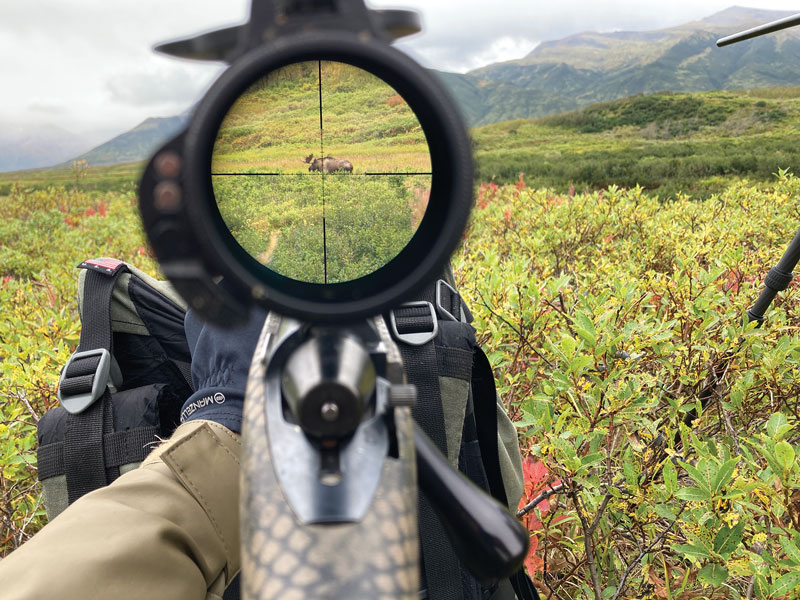
It’s difficult to be quiet while walking in ankle-deep water, and this story from several years ago finds three of us mimicking a herd of elephants more than the stealthy hunters we needed to be. Splashing across the shallowest part of the oxbow, we used the opposite bank for cover and nearly sprinted 200 yards to a shallow depression in the ridge that separated us from our quarry. Peeking slowly above the thick brush, the image in front of us sucked our breath away—and remains today a scene burned into my memory. Looking for the cow he could have sworn he had just heard calling his name, a bull moose milled in confusion just 240 yards from our vantage point. His generous rack had all my attention, and his enormous gray body looked like a giant billboard against the willows. Scanning through the rifle scope at the numerous points and wide paddles, an unstoppable wave of alarm hit me, and what came out of my mouth was pure, unedited, Sarah: “He doesn’t make it on brow tines!” I hissed to the others.
Brow Tines or Bust
This and prior moose hunts had been prefaced with the familiar crash course from Antler University—a broomstick fixed to the back fence, visual measuring practice on every training hike, moose-judging videos on looped playback, but the moment of truth for me had always come down to brow-tine count. My desire to keep the animal after the colossal effort involved in recovery caused me to pause prior to pulling the trigger, and I’ve been known to pass up line-toeing legal bulls for one that left no doubt. So ingrained was this caution, that even in the presence of this beast who looked as though he held a sheet of plywood on his ears, my immediate instinct was to let him walk. “He doesn’t make it on brow tines!”
A whispered reply came through choked laughter, the kind that hopes you’re not serious. “I don’t care! He’s huge!!” My hunt partner hissed back. The safeties clicked off, and the firing squad commenced, anchoring the bull before he made it to the river only 50 yards away. The bull measured a whopping 65 inches green.
You couldn’t ask for a more perfect hunt, though somewhat sheepishly, I was left hungry for a more reliable assessment standard. Using a reticle for measuring is not a new subject and there’s limited space here to deep dive, but with this article, I’d like to introduce ways your scopes’ reticle can benefit you in the field beyond its traditional role.
Choices:
Optic transactions at the retail level don’t generally start with the customer asking to see “the best tape measure you’ve got!” But focal plane and reticle choice should be considered in depth if you’re looking to expand your optic’s utility to include measurement.
Second Focal Plane (SFP) scopes are those which retain reticle size across the magnification range. These most commonly publish a reticle-based measurement of some kind when the scope is on its highest magnification. Beware, as some brands employ a “manufacturer’s suggested magnification” for the same, a data point you’ll want to collect prior to going to the field. Know for certain the magnification setting that determines your SFP scope reticle’s specific increments.
In a First Focal Plane (FFP) scope, the reticle grows or shrinks with an increase or decrease of magnification. This is so the “measuring tape” is preserved across the magnification range. Regardless of power, in FFP scope reticles, a milliradian (MIL) still measures a MIL, and a minute of angle (MOA) still measures an MOA.
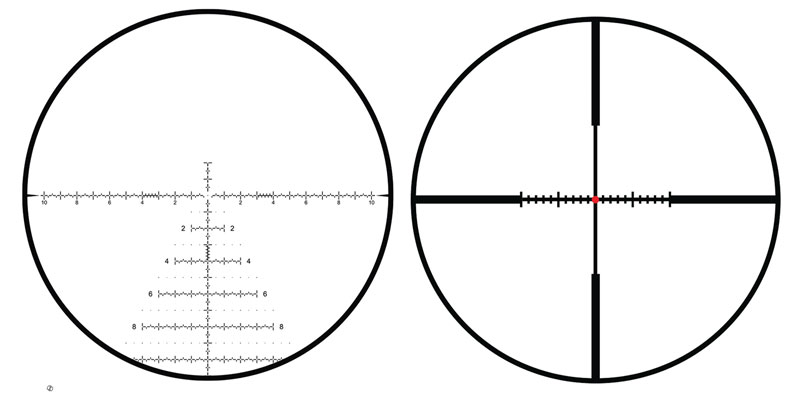
Conversations revolving around measurements or holdovers generally refer to reticles with sub tensions—commonly lines, dots, or circles surrounding the center crosshair indicating calibrated units of measure. See Image on page 22.
But it’s not just “tree-style” reticles that can provide measuring feedback. Even some of the most basic reticles can be of use if you know what to look for!
Solving for Size:
Leupold Optics publishes that a VX-3HD 3.5-10 (second focal plane) scope with a basic duplex reticle measures 5.1 MOA between the center of the crosshair to where the reticle posts begin to thicken. This measurement is only correct if this scope is on max power (10 in this scope’s case), and every scope model or power range has a different measurement. Know your scope!
Even this SFP scope and basic reticle can help us with a moose rack measurement if we work out the solution. In this case, X (the unknown) is width in inches. We start with the knowns: range is 475 yards, MOA value at that distance is ~5.2 inches, the middle crosshair measurement equals 5.1 MOA with the scope on its highest magnification, which translates to a reticle measurement of ~26.5 inches. Thus, 2 crosshair widths at this distance = 53 inches. Not useful for exact math, but a method helpful when a quick calculation can determine if the bull in question is worth chasing or if you need to move on to the next one. Based on the needed accuracy, rounding the math creates a faster solution, while staying with the detailed numbers limits your margin for error. Don’t be afraid to employ the calculator on your phone!
In the instance of a FFP scope, you’d need to know the yardage and translate that back to what you know about MILs or MOA converted to inches (sounds complicated but isn’t!). As an example, at 500 yards 1 MIL = 18” so you’d need to measure 3 MILs to achieve a 54-inch standard. For MOA, at 500 yards 1 MOA = roughly 5.24”, so you’d need to measure 10.3 MOA to achieve the 54-inch standard. Keeping a basic knowledge or a phone-stored chart of MOA or MILs converted to inches can save time in the field!
Solving for Yardage:
Bullet/ammo, rifle, and optic technology has never been as advanced as it is now, and “ethical hunting range” has never been as distant, making the value of an accurate distance indispensable. If a rangefinder goes down, or happens to get left behind in camp, the hunt doesn’t need to be over. At an NRL match I Range Officered earlier this year, I saw a dozen rangefinders of all brands fail on the clock for a variety of reasons. It’s worth arming yourself with some simple knowledge to ensure an effective range estimation without the need for a laser. Though solving-for-X-style math may not have been a favorite part of your academic era, the hunter in you may motivate a refresh with a more practical application. You’ll need to know what type of reticle you’re shooting (dials or turrets don’t matter here) and what the sub-tension values are, as well as a relative dimension in inches, like the forehead width between a moose’s ears, or the average girth of a caribou. A known value needs to be established; then you can work the solution.
Let’s use an example of a Sitka blacktail deer—a small target that’s easily missed or wounded if the range estimation is off.
We start with the knowns: the sub tensions on our FFP Scope are in MIL, and the average Sitka buck measures 18” from saddle to the bottom of the brisket. We also know that we need the number 27.77 to calculate distance for MILs, and 95.5 for MOA. Then from there it’s a simple calculation: 18 x 27.77 = 499.86 divided by the number of MILs the body cavity is filling in your reticle, in this story it’s 1.5 MILs, and we come up with 333.24, the distance in yards.
Let’s calculate in MOA with an SFP scope (the one we used earlier). Same deer, but this time the sub tensions are in MOA, and there’s just the bracket measurement of 5.1 MOA for reference. We’re on 10 power, and the deer fills about 3/4 of the reticle measurement. 18 (inches of deer) x 95.5 = 1,719 divided by the number of MOA the body cavity is filling, in this case, 4, equals 429.75, the solution in yards. Knowing a few things about yardage estimation can save your hunt if a rangefinder ends up lacking.
Solving for a Wind Call:
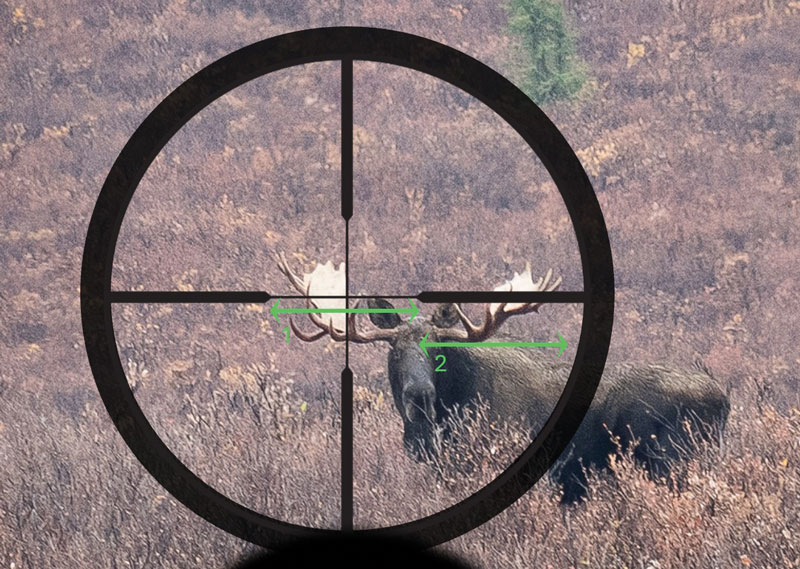
You choose to go with your panic wind call and send a round downrange impacting low off the right edge of the intended target (image at right, left side). The trigger press felt good, so trusting your shooting fundamentals to have been solid, you hold the impact point (image at right, right side) on target and press a follow up shot for the impact. In our after-action assessment, we evaluate the miss and correction against our initial wind call and realize that what we thought was a quartering wind, must have been a full-value side wind, or a higher speed than originally anticipated. In this case it matters not what magnification you’re on, not what reticle you’re using, MIL or MOA, or even first or second focal plane. It only matters that you visually mark the miss and hold that far in the opposite direction of the miss for the follow up shot. Wind calls are easiest with tree-style reticles or at least with wind hashes/windage sub tensions. Read the article “Behind the Rifle” in the 2025 Spring issue of Hunt Alaska for some helpful hints on staying behind your rifle to spot your impacts and misses! You can’t measure and adjust for what you don’t see.
It doesn’t take a high level of math to understand the value of knowing your reticle and how it can assist the hunter and shooter. The more data points we have, the faster we can come up with a solution for an unknown and the more prepared we are to perform in a pressured moment. Understanding your reticle and its various field aids adds confidence to your skillset and potentially more wild-game steaks to your deep freeze.
If the traditional center crosshair hold results in a well-sent miss off target, visually mark the miss, and hold that distance to the other side of the target for a follow up impact. © Sarah Stallone

Want to build these skills with hands-on instruction? View our wide range of Accurate Advantage Courses.

Sarah Stallone
About the Author
Sarah Stallone is an outdoor writer and contributor to Hunt Alaska magazine, firearms instructor, and Territory Manager for Leupold Optics with more than 30 years of experience in the field and on the range. As founder of Accurate Advantage, she teaches everything from home defense and bear safety to precision rifle, where she also competes at the national level. A wife and mom based in Alaska, Sarah finds her best material spending time in the wilderness with friends and family.